
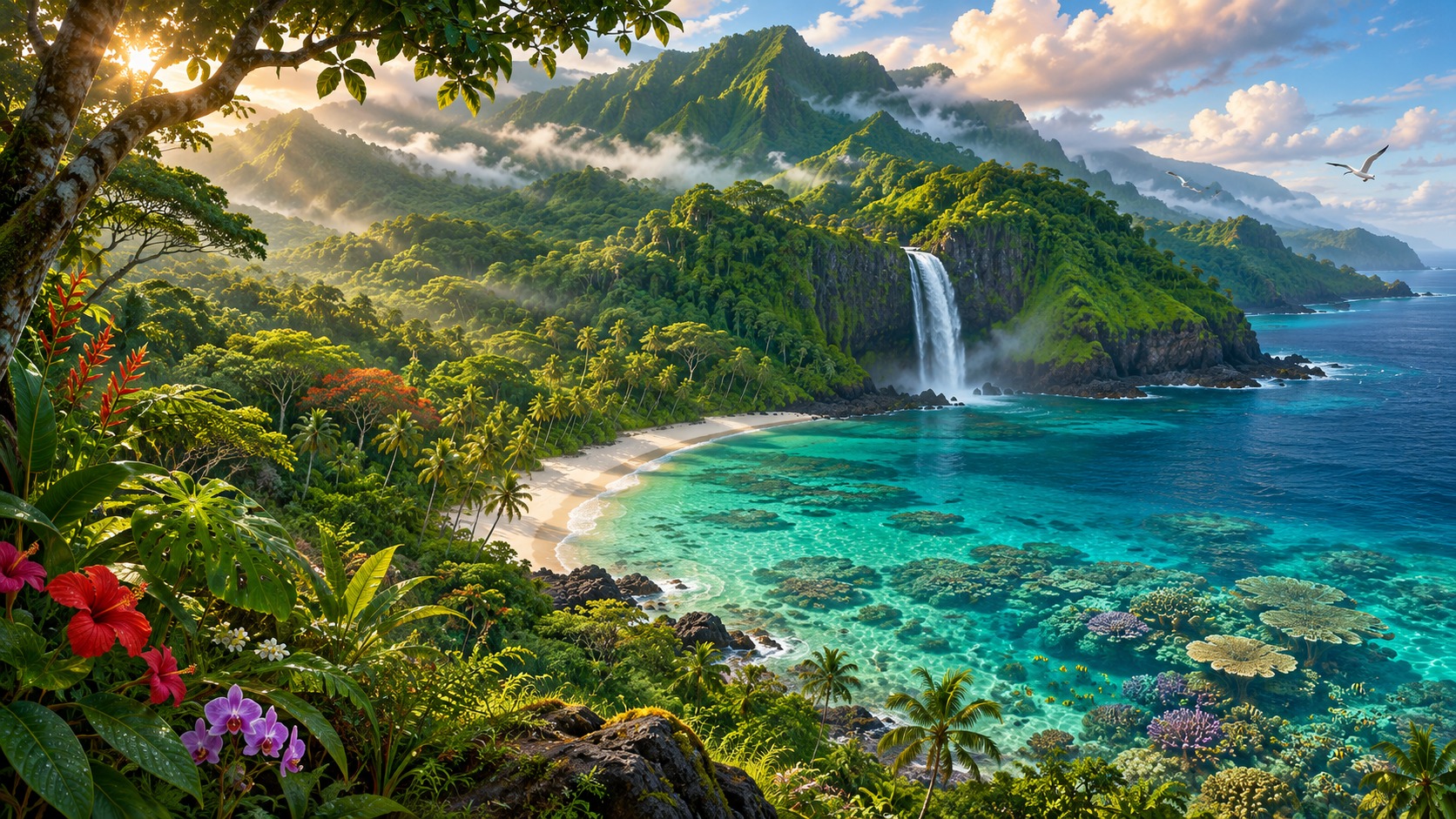
A world worth stopping to wonder at. AI-generated editorial illustration of an imagined tropical coastline, created with OpenAI.
Perhaps you checked your phone. Made some coffee. Thought about everything you needed to do.
Meanwhile, you were standing on a planet with oceans, beneath a sky with clouds, in a universe where we have yet to find another living world.
Beauty doesn’t have a scientific league table. But before you nominate somewhere else, take a moment to consider this place.
Really consider it.
We live somewhere a moon can hide a star.
The Sun is about 400 times wider than the Moon.
An enormous star, beside a rocky Moon so much smaller.
And yet the Sun is also about 400 times farther away. Those two differences almost perfectly cancel out. From where we stand, these vastly different objects appear nearly the same size.
When their positions and distances line up for a total eclipse, the Moon covers the Sun’s bright face. Daylight fades. A delicate white halo appears around a black circle in the sky.
Just stop and picture that. Our little Moon can hide the enormous star that lights our world. And we get to stand here and watch.
The fit changes as their distances change. Some eclipses leave a ring of sunlight instead. Knowing the geometry makes the spectacle no less astonishing.
Imagine visiting Earth from somewhere else and discovering that this happens here.
You would probably tell everyone back home.
Some of this planet’s most remarkable ingredients became you.
Look at your hand.
Really look at it.
The carbon inside it was made in stars. So was the oxygen that helps keep you alive. The hydrogen in your body reaches back even further, to the early universe.
Long before Earth existed, some of your ingredients were already out there.
Eventually, those ingredients became part of someone who could hold another person’s hand. Draw a picture. Build a telescope. Ask where everything came from.
Atoms forged inside stars are now part of someone who can look up and wonder about them. You.
Let that sink in before you read on.
Here, water falls from the sky.
We call it rain. Sometimes we complain about it.
But think about what is happening.
Water rises from oceans and land, gathers into clouds, then falls to the ground. It fills rivers, feeds forests and moves through living things.
Earth orbits in a region where liquid water can remain on a planet’s surface, given a suitable atmosphere. Our distance from the Sun matters, alongside the atmosphere and the other conditions that make this a living world.
The result is a place where you can stand beneath a waterfall. Float in the sea. Watch raindrops gather on a leaf.
Imagine discovering a planet like that through a telescope. Imagine the excitement.
Then remember: this is where you woke up this morning.
And the oceans are alive.
They contain coral reefs, seagrass meadows and animals whose lives unfold almost entirely beyond our sight.
Above the water, birds cross the sky. Trees grow towards the light. Somewhere, a child is turning over a stone to see what lives underneath.
We have discovered thousands of planets around other stars, including worlds in regions where liquid water might be possible. But potentially habitable does not mean inhabited. We still have no confirmed evidence of life beyond Earth.
We don’t yet know whether living worlds are common or exceptionally rare.
For now, every forest we know exists is here. Every wild animal we have encountered. Every person we have ever loved.
Somewhere in the enormous universe, there is a planet where the sea is full of life and people laugh around kitchen tables. We live there.
How did that become something we barely notice?
You don’t need a spaceship to explore it.
At Dubai Future Week, a session called Dear Future Me, Remember to Wonder featured marine ecologist Dr Reem AlMealla and was moderated by Barbara Doran, President of The Explorers Club.
AlMealla’s work explores coral reefs, seagrass and marine wildlife. Her field of discovery is right here, on the planet we sometimes forget to be curious about.
The session’s title is an invitation worth keeping.
Begin with The Explorers Club’s films and talks. Then take that curiosity outside. Explore a shoreline. Join a guided nature walk. Visit a planetarium. Look at the Moon with someone who has never really studied it before.
With a child, ask: What’s the strangest thing you noticed?
Give yourself permission to be just as amazed by the answer.
Tonight, the Moon will still be circling our world. Your body will still carry ingredients made in stars. Somewhere in the darkness, an ocean will be moving against a shore.
All of this will be happening while we make dinner, answer messages and think about tomorrow.
So, what’s it like to live on the most beautiful planet in the known universe?
Take a look around before you answer.
Go a little deeper
Read the original source: The Explorers Club — films and talksWe separate reported developments from our interpretation of what they could mean. Possibility is not a promise.